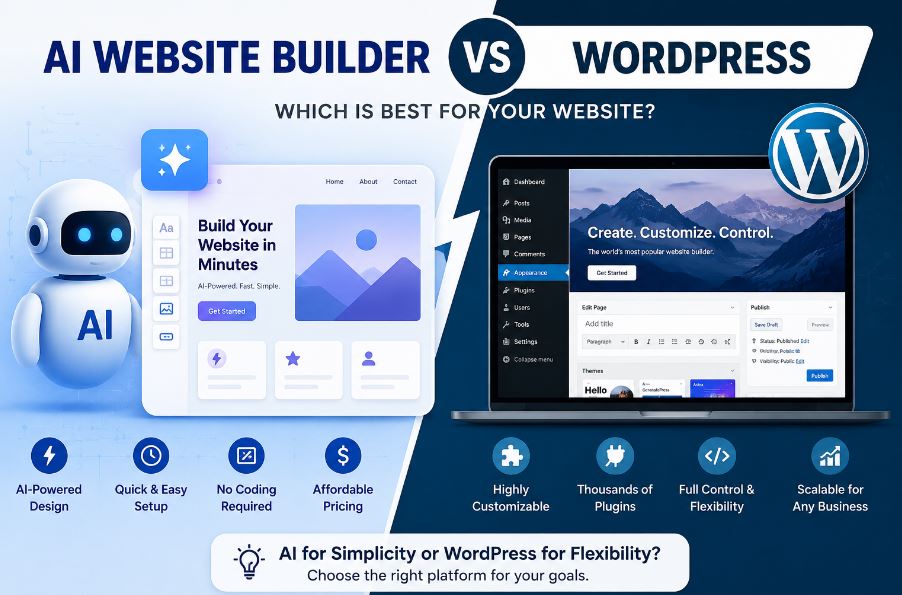
The AI website builder vs WordPress question is one I get asked constantly these days, and after fifteen years of building, migrating, and rescuing websites for clients, I’ll say this upfront: it’s not the simple either/or debate most articles make it out to be. I’ve spent the last few months personally testing several of the newer AI builders against a standard WordPress setup, and the honest answer is that both platforms have earned their place just not for the same kind of project.
What’s changed recently is worth noting before we go further. A newer generation of agentic AI builders now creates complete, standalone sites with hosting built in, rather than just generating a WordPress site behind the scenes the way earlier AI tools did. This means the real choice today involves three distinct paths rather than a single either/or decision: manual WordPress, AI-assisted WordPress, and a fully agentic AI builder that operates on its own platform. Understanding which of these three you’re actually comparing changes how you should think about the AI website builder vs WordPress decision.
Why This Comparison Confuses So Many People
Most people entering the AI website builder vs WordPress debate assume they’re comparing two competing types of software. In reality, they’re often comparing a method against a platform. Several of the most popular “AI website builders,” including tools like ZipWP and 10Web don’t build something entirely new; they actually generate a WordPress website behind the scenes, meaning the real comparison in many cases is AI-assisted WordPress versus a manually built WordPress site rather than AI versus WordPress itself. True standalone AI builders, on the other hand, run entirely on their own infrastructure and don’t touch WordPress at all.
I bring this distinction up early because it genuinely changes your decision. If you pick what you think is a “true AI builder” but it’s secretly WordPress underneath, you inherit WordPress’s maintenance responsibilities whether you realize it or not.
Speed: Where AI Website Builders Win Decisively
If launch speed is your priority, there’s no honest way to argue WordPress wins here. Industry data suggests AI website builders can generate a site five to eight times faster than traditional methods, with build times ranging from thirty seconds to ten minutes compared to an average of eight or more hours for a manual WordPress setup. In my own testing, a standard manual WordPress build, hosting, theme selection, plugin configuration, and initial content regularly landed somewhere between fifteen and twenty hours once you account for the small decisions that add up along the way.
That said, an AI-assisted WordPress build narrows this gap considerably. Rather than requiring a multi-day process, AI-assisted WordPress compresses setup into a single focused session where you answer a questionnaire, let the AI generate the site structure, and then spend your time refining content instead of starting from a blank page. If speed matters but you still want WordPress underneath, this middle path is often the smartest compromise in the AI website builder vs WordPress conversation.
SEO: Where WordPress Still Has the Edge
This is the part of the AI website builder vs WordPress debate where I see the most misinformation online. AI builders have gotten genuinely good at handling the basics. Meta titles, descriptions, alt text, and a sitemap are usually generated automatically without extra setup. But basic SEO and competitive SEO are two very different things.
According to industry SEO comparisons, WordPress provides significantly more control over site architecture, metadata, schema, internal linking, and content management than most AI website builder platforms currently offer. I’ve watched this play out directly with clients: an AI-built site for a local business will often rank fine for branded searches (the business’s own name) but struggles the moment it needs to compete for broader, higher-value local search terms without deeper technical optimization.
If your growth plan depends on organic search traffic from a large content library, dozens or hundreds of blog posts, structured schema markup, and granular internal linking, WordPress’s flexibility still isn’t something most AI builders have fully caught up to, even in 2026.
Cost: The Comparison People Get Wrong Early On
Cost is usually the deciding factor for smaller businesses, and it’s also the one I see people misjudge the most, because they only look at the first month’s price. A $3-per-month AI builder plan can jump to $11 per month or more at renewal — still affordable, but a meaningful jump that’s worth budgeting for before committing to a multi-year plan.
WordPress works differently. Setup costs can look higher upfront for hosting, a premium theme, and maybe a handful of paid plugins but those costs tend to flatten out over time, and you retain full ownership of what you’ve built rather than renting access to a platform’s infrastructure. In my experience managing sites for clients over multi-year periods, WordPress consistently comes out cheaper in year two and beyond, particularly once a site’s content library and traffic start to grow.
Ownership and Platform Lock-In
This is the factor that gets the least attention in most AI website builder vs WordPress comparisons, and it’s arguably the most important one long-term. Because AI platforms host your site within their own ecosystem, your data and design remain tied to that specific provider, and in most cases you cannot simply export the complete site to another host if you decide to switch later.
WordPress, by contrast, is open-source software that you install on hosting you control. You can migrate hosts, switch themes, change developers, or rebuild the front end entirely, all without losing your content or your domain’s search authority. I’ve personally handled several client migrations off AI Builder platforms specifically because they hit this lock-in wall a year or two after launch by then, rebuilding from scratch was often the only real option.
Plugin Ecosystem and Advanced Functionality
WordPress currently offers access to over 60,000 plugins covering nearly every conceivable feature, from booking systems and membership portals to multilingual support and advanced e-commerce. If your project needs something specific, like a custom booking flow, a learning management system, or complex WooCommerce logic with non-standard shipping rules, there’s very likely already a mature, battle-tested WordPress plugin built for exactly that use case.
AI builders are improving here, but complex functionality like subscription logic, custom product configurators, or non-trivial payment gateway configurations still tends to break down once you try to layer them onto an AI-generated site structure, often becoming harder to configure than simply building the feature from scratch would have been. I’d treat this as one of the clearest dividing lines in the AI website builder vs WordPress decision: simple sites tolerate AI builder limitations fine; feature-heavy sites usually don’t.
Maintenance and Long-Term Upkeep
WordPress asks more of you after launch than most AI builders do. Running a WordPress site well requires ongoing attention to core updates, plugin updates, theme updates, PHP version upgrades, security patches, database optimization, and backup management. This is precisely why we cover WordPress security plugins in detail elsewhere on this blog. Without a proper security layer, an unmaintained WordPress install becomes a real liability rather than an asset.
AI builders remove nearly all of this burden, since the platform itself handles hosting, security patching, and infrastructure entirely. That’s a genuine advantage for a business owner who simply doesn’t have the time or interest to manage a CMS. It’s also worth pairing whichever platform you choose with a solid WordPress backup strategy if you do go the WordPress route, since ongoing maintenance and disaster recovery go hand in hand.
So, Which Should You Actually Choose?
After testing both approaches extensively, here’s the practical framework I give clients:
- Choose an AI website builder if you need a simple, professional site live within hours, you don’t plan to publish large volumes of content, and you’re comfortable with some platform lock-in in exchange for zero maintenance overhead.
- Choose AI-assisted WordPress if you want the speed of an AI-generated starting point but still want to retain WordPress’s flexibility, plugin ecosystem, and long-term SEO control underneath.
- Choose manual WordPress if you’re building a content-heavy site, a serious e-commerce store, or a business asset you expect to actively grow and optimize for years, and either have technical support available or are willing to learn.
The way I’d frame it after all this testing: AI builders are launch tools, while WordPress remains a growth tool — and the right choice depends far less on which platform is “better” in the abstract and far more on what you’re actually planning to build.
Frequently Asked Questions
Is an AI website builder actually good enough for a small business site?
For a simple brochure-style site hours, location, services, and contact information, yes, an AI website builder is often more than sufficient and considerably faster to launch than WordPress.
Do AI website builders hurt my SEO long-term?
Not necessarily at first, but most AI builders limit how deeply you can optimize site architecture, schema, and internal linking as your content grows, which becomes a real constraint once you’re competing for non-branded search terms.
Can I move my site from an AI builder to WordPress later?
In most cases, migration is limited; you’ll likely need to manually rebuild content and design rather than exporting the site cleanly, so it’s worth thinking about this before you commit to a platform.
Is WordPress still worth learning in 2026 with AI builders available?
Yes, particularly if you expect your site to scale into a content hub, an online store, or a lead-generation asset. WordPress’s plugin ecosystem and SEO control remain difficult for AI builders to fully match.
Which option is cheaper in the long run?
WordPress is usually cheaper over a multi-year horizon since AI builder subscriptions often increase at renewal, while WordPress costs tend to stabilize once your hosting and plugin stack are set.
Conclusion
After fifteen years working across both traditional CMS platforms and the newer generation of AI tools, my honest conclusion is that the AI website builder vs WordPress debate isn’t really about which platform is objectively superior; it’s about matching the tool to the timeline you’re actually working with. If you need something live today with minimal ongoing effort, an AI builder will serve you well. If you’re building something you expect to still be growing, ranking, and generating revenue three years from now, WordPress remains the platform I’d put my own reputation behind.
Whichever path you choose, don’t treat the decision as permanent or irreversible without doing your homework first. Understand the lock-in risks, test the SEO controls you’ll actually need, and be honest with yourself about how much ongoing maintenance you’re willing to take on. That single piece of upfront thinking will save you far more time than either platform’s setup wizard ever could.
Do AI website builders hurt my SEO long-term?
In most cases, migration is limited; you’ll likely need to manually rebuild content and design rather than exporting the site cleanly, so it’s worth thinking about this before you commit to a platform.
Is an AI website builder actually good enough for a small business site?
For a simple brochure-style site hours, location, services, and contact information, yes, an AI website builder is often more than sufficient and considerably faster to launch than WordPress.
Can I move my site from an AI builder to WordPress later?
In most cases, migration is limited; you’ll likely need to manually rebuild content and design rather than exporting the site cleanly, so it’s worth thinking about this before you commit to a platform.
Is WordPress still worth learning in 2026 with AI builders available?
Yes, particularly if you expect your site to scale into a content hub, an online store, or a lead-generation asset. WordPress’s plugin ecosystem and SEO control remain difficult for AI builders to fully match.
Which option is cheaper in the long run?
WordPress is usually cheaper over a multi-year horizon since AI builder subscriptions often increase at renewal, while WordPress costs tend to stabilize once your hosting and plugin stack are set.